From Shipper to Shaper: The IC-to-Product Leader Transition
Transitioning from IC to product leader? Learn how to escape the execution trap, shift your mindset from doing to enabling, and scale your team's impact.

Product Leader Academy
PM Education
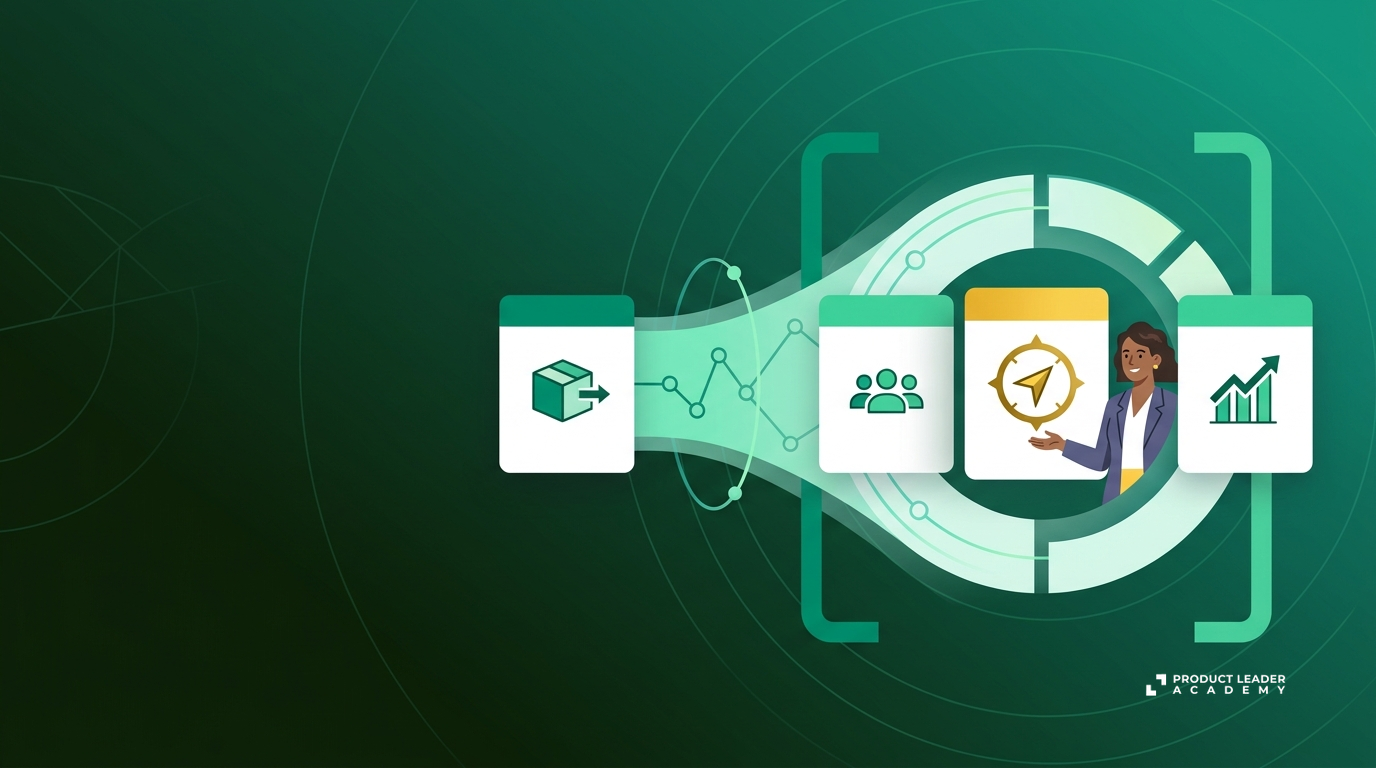
You just got promoted to Group PM or Director. Or perhaps you are a Principal PM stepping into your first people management role.
For years, your professional currency was direct execution. You wrote the cleanest PRDs, mapped out flawless user journeys, and unblocked engineering at 9 PM on a Friday. Now, your calendar is a wall of pastel blocks, your Slack is a firehose of stakeholder escalations, and you haven't touched a Figma file or a Jira ticket in a month. You feel incredibly busy, yet you go to sleep wondering: What did I actually build today?
This is the paradox of the product promotion. The exact skills that made you an elite Individual Contributor (IC)—meticulous attention to detail, deep domain expertise, and a hands-on approach to execution—are the very skills that will break you as a leader.
When you ship a feature, the feedback loop is immediate and satisfying. Code deploys, metrics tick upward, and users show their appreciation. When you lead a team, your work is indirect. Your output is no longer a product; your output is a team that builds products. This transition triggers a profound identity crisis for high-achieving PMs.
True product leadership is not about being the smartest PM in the room. It is about creating an environment where your team can be the smartest PMs in the room. To survive and thrive, you must shift your identity from a "Shipper" to a "Shaper."
Shift 1: From "Doing" to "Enabling" (Overcoming the Execution Trap)
When stress levels rise, humans default to their comfort zones. For a newly promoted product leader, that comfort zone is execution. If an engineering estimate is late, a design review stalls, or a launch goes rocky, your instinct is to jump into the trenches, rewrite the user stories, and run the standup yourself.
This is the Execution Trap.
When you slide back into "doing" mode, you create three severe organizational bottlenecks:
- You stifle your PMs' growth: If you solve every hard problem, your team never learns to think critically. They become order-takers who wait for your instructions.
- You bottleneck the roadmap: You do not have the bandwidth to design features and set global strategy. By doing both, you delay execution across the entire portfolio.
- You destroy trust: Your team perceives your hands-on intervention as micromanagement. They stop taking ownership because they assume you will rewrite their work anyway.
To scale your impact, you must replace direct execution with the Commander’s Intent framework.
The Commander’s Intent Framework
Originating in military strategy, Commander’s Intent defines a clear, concise statement of what the team must achieve and why, without specifying how they must achieve it. It empowers decentralized teams to make rapid tactical decisions in high-stress situations because they understand the ultimate objective.
In product management, this means you define the strategic goals and customer problems, while leaving the solutions and feature definitions entirely to your PMs.
| Dimension | The IC Mindset (How) | The Leader Mindset (What & Why) |
|---|---|---|
| Objective | "Build a multi-factor authentication flow using SMS and authenticator apps." | "Secure user accounts to reduce unauthorized access incidents by 40% this quarter." |
| Scope | Specifying the exact UI components, button placements, and API endpoints. | Setting guardrails: The solution must not increase checkout friction by more than 2%. |
| Success Metric | Feature shipped on time. | Drop in account compromise rate. |
Establishing Clear Guardrails
Autonomy without alignment is chaos. To safely delegate the "how," you must establish clear guardrails. Guardrails are the non-negotiable boundaries within which your PMs have absolute autonomy to make decisions.
Define these guardrails explicitly:
- Financial: "You have the budget to run three user acquisition tests up to $10,000 each without leadership approval."
- Operational: "Any architectural change that increases API latency by more than 50ms must be reviewed by the engineering lead."
- Brand/UX: "All new UI elements must strictly adhere to our design system tokens. Custom components require design director sign-off."
Building Scalable Operating Systems
Instead of writing PRDs, your job is now to design the operating system that enables your team to write excellent PRDs. This is the foundation of Product Ops.
You must define and standardize:
- The PRD Template: What level of customer discovery, data analysis, and technical risk assessment is required before a project is greenlit?
- The RFC (Request for Comments) Cadence: How do PMs solicit feedback from Engineering, Design, Security, and Legal without scheduling endless meetings?
- The Product Review: A weekly or bi-weekly forum where PMs present their strategic bets to you and their peers for constructive critique, not for permission.
By building these systems, you ensure quality at scale without needing to be in the room for every decision.
Shift 2: From Feature Delivery to Strategic Alignment
As an IC, your calendar was optimized for focus time and team-level execution rituals: standups, backlog grooming, and retro sessions. As a leader, your calendar must reflect your new responsibility: aligning your team's output with the broader business strategy.
Redefining Your Calendar
If your calendar still looks like an IC's calendar, you are failing your team. You must shift your time allocation away from daily execution toward strategic planning, market analysis, and executive alignment.
| Role | Allocation | Focus Areas |
|---|---|---|
| IC Calendar | 40% | Standups, Sprint Planning, Jira |
| 30% | Spec Writing, Figma Reviews | |
| 20% | Customer Calls & Discovery | |
| 10% | Stakeholder Management | |
| Product Leader Calendar | 30% | Cross-functional Alignment (Execs, Sales, Marketing) |
| 30% | Strategic Planning & Market Research | |
| 25% | Coaching & 1:1s | |
| 15% | Operational Reviews & Metrics |
Managing Up and Sideways
Executive communication requires a complete translation of your vocabulary. The executive team—the CEO, CFO, and Head of Sales—does not care about your sprint velocity, story points, or whether a feature is built with a specific technical framework. They care about business outcomes: Customer Acquisition Cost (CAC), Lifetime Value (LTV), Annual Recurring Revenue (ARR), and Churn.
When communicating upward, translate product output into business impact.
- The IC Way: "We are launching an updated onboarding flow next week to make it easier for users to invite their teammates."
- The Leader Way: "We are launching a viral loop in our onboarding flow next week. Our target is to increase the user-to-workspace invitation rate by 15% within 30 days, which we project will reduce our blended CAC by 8%."
Sideways alignment is equally critical. You must build a unified triad with your Engineering and Design peers. You are no longer separate departments negotiating over resources; you are a single leadership unit co-owning a business outcome. If a project fails, the triad fails together.
The Art of Saying "No" at Scale
As an IC, you said "no" to individual feature requests from sales or support to keep your sprint focused. As a leader, you must say "no" to entire strategic directions, customer segments, or business units.
If the sales team demands custom enterprise features that deviate from your core self-serve SaaS product strategy, you cannot simply tell them, "It's not on the roadmap." You must defend your strategy using opportunity sizing, resource allocation data, and business trade-offs.
Show them what the business loses if you say "yes": "If we assign two squads to build this custom enterprise integration, we will delay our core API platform launch by six months, which puts $3M of projected PLG revenue at risk. Is this single customer contract worth that trade-off?"
Shift 3: From Individual Output to Team Performance (The People & Power Shift)
When you become a people manager, your definition of a successful day changes completely. You no longer win by being the individual who solved the hardest problem or stayed up latest to finish a launch. You win when your team succeeds, and you take responsibility when they fail.
The Authority Paradox: From Peer to Boss
Transitioning from a peer to a manager within the same organization is one of the most socially complex moves you will make. It is easy to fall into one of two traps:
- The Soft Trap: Trying to remain "one of the peers." You avoid tough performance conversations, let sub-standard work slide, and try to make everyone happy to avoid conflict. This leads to a culture of mediocrity.
- The Dictator Trap: Overcompensating for your new authority by pulling rank, making unilateral decisions, and demanding compliance. This destroys trust and drives away your top talent.
The solution is radical transparency combined with clear boundary setting. Address the transition directly in your first 1:1s:
"Our working relationship is changing. My role now is to hold our team to an elite standard and unblock your career growth. That means I am going to challenge your assumptions and push your strategic thinking harder than before, but it also means I will advocate for your advancement in rooms you aren't in. Let’s talk about how we can make this transition successful for both of us."
Coaching vs. Directing (The Socratic Method)
When a PM comes to you with a problem—such as "The engineering team says this database migration will take six weeks and we will miss our launch date"—your immediate instinct will be to tell them how to fix it.
Do not do this. You are robbing them of a learning opportunity.
Instead, use the Socratic Method to coach them toward their own solution. Ask open-ended, guiding questions:
PM: "We're going to miss the Q3 launch because of the database migration."
You: "What is the primary technical bottleneck the engineering team identified?"
PM: "They need to run data validation checks on 10 million legacy records."
You: "What are the risks of running those validation checks in phases post-launch instead of all at once?"
PM: "We might have some data inconsistency for older accounts, but we could shield that with a feature flag."
You: "What would a phased rollout plan look like, and how would that impact our launch timeline?"
PM: "If we limit the initial launch to accounts created in the last 12 months, we can bypass the legacy migration for now and ship on time."
You: "Excellent. Go draft that proposal with the tech lead, map out the customer impact, and let's review it tomorrow."
By asking questions instead of giving answers, you teach your PMs how to think, not what to think.
Tailoring Your Style to PM Maturity
You cannot manage every PM the same way. You must adapt your leadership style based on the maturity and capability of the individual.
| Support / Mentorship (Y-Axis) | PM Capability / Maturity (X-Axis) | Leadership Style | Details & Focus |
|---|---|---|---|
| High | High | Coaching Style<br>(Medium Support, Low Direction) | • Senior PMs<br>• Focus on strategic alignment<br>• Sounding board for trade-offs |
| Low | Low | Directive Style<br>(High Support, High Direction) | • Associate PMs<br>• Step-by-step guidance<br>• Frequent check-ins & reviews |
- Associate PMs (High Support, High Direction): They need tactical guidance. Provide templates, review their drafts early, check in frequently, and help them navigate cross-functional relationships.
- Senior PMs (Medium Support, Low Direction): They understand execution but need help with long-term strategy and executive presence. Act as a sounding board, challenge their business cases, and help them manage up.
- Principal/Lead PMs (Low Support, Low Direction): Give them full ownership of a strategic pillar. Step in only to resolve high-level organizational dependencies or to provide executive coverage.
Tactical Roadmap: Your First 90 Days as a Product Leader
When you step into a leadership role, you have a brief window of objective neutrality. Use it wisely. Do not try to rewrite the company strategy in your first week. Follow this structured 90-day plan to build credibility and establish your operating model.
Days 1–30: The Listening Tour
Your goal in the first month is to gather raw diagnostic data and build trust. Do not make any major strategic changes or process adjustments.
Conduct structured 1:1s with your direct reports, your cross-functional peers (Engineering, Design, Sales, Marketing, Support), and at least five key customers. In every internal meeting, ask these three diagnostic questions:
- "What is working exceptionally well in our current product development process?"
- "What is the single biggest bottleneck slowing your team down right now?"
- "If you had a magic wand and could change one thing about our product strategy, what would it be?"
Document the answers. Look for patterns, recurring pain points, and misalignments between departments.
Days 31–60: Assess, Align, and Buffer
Use your second month to evaluate your team's capabilities, establish your operational rhythm, and start protecting your team from external noise.
- Perform a Talent Assessment: Identify your high performers, those who need coaching, and any critical skill gaps in the organization.
- Establish Your Operational Cadence: Set up your weekly 1:1s, team syncs, and monthly business reviews. Clearly communicate the purpose and expectations for each meeting.
- Act as a Shock Absorber: Start filtering executive requests. When a senior stakeholder demands an ad-hoc feature, do not pass that stress directly to your PMs. Filter it, evaluate it against your current priorities, and handle the negotiation yourself.
- Secure 1-2 Quick Wins: Identify low-hanging operational problems that you can fix quickly (e.g., streamlining a broken design handoff process or eliminating an unnecessary weekly status report). Fixing these builds immediate operational credibility.
Days 61–90: Establish the Strategy
By month three, you have the context and credibility to set the future direction of your product organization.
- Draft the Strategic Pillars: Based on your listening tour and market analysis, define three core strategic pillars for your product line.
- Align the Triad: Review and refine these pillars with your Engineering and Design peers until you have absolute alignment.
- Communicate the Vision: Present the updated strategy to your team and executive stakeholders. Connect every squad's daily work directly to one of your strategic pillars.
- Set the OKRs: Establish clear, measurable Key Results for the upcoming cycle that align with your strategic pillars.
Common Pitfalls to Avoid (The Warning Signs)
Keep a close eye on these red flags. If you recognize these patterns in your weekly work, you are sliding back into IC habits.
The "Hero PM" Syndrome
A critical launch is slipping, so you step in, take over the PRD, and run the daily standups yourself.
- The Danger: You humiliate the assigned PM, signal to the engineering team that you don't trust your own people, and burn yourself out. Instead of coaching them to navigate the crisis, you've temporarily solved a symptom while worsening the underlying systemic issue.
The Process Bureaucracy Trap
To regain a sense of control over a growing team, you implement excessive templates, weekly status reports, and mandatory sign-offs.
- The Danger: You slow down execution, turn creative PMs into administrative checkbox-checkers, and build a culture of risk aversion. Keep processes lightweight, focused purely on enablement rather than control.
The Feedback Vacuum
You only discuss performance and constructive critique during formal annual reviews, avoiding uncomfortable feedback conversations in your weekly 1:1s.
- The Danger: PMs assume everything is fine until their performance review, leading to shock, resentment, and high turnover. Deliver continuous, micro-feedback in real-time.
Protecting the Team to a Fault
You shield your team from organizational noise, executive pivots, and harsh business realities so thoroughly that they work in a complete bubble.
- The Danger: Your team becomes disconnected from the broader business strategy, spending valuable cycles building features that no longer align with the company's North Star.
Conclusion: Embracing Your New Identity
Redefining a "Good Day's Work"
As a leader, you must accept that your calendar will no longer yield tangible, daily artifacts. A successful day might not produce a finished document or a shipped feature. Instead, it might look like:
- A breakthrough coaching session where a junior PM finally learns to prioritize using opportunity sizing.
- A difficult alignment meeting where you successfully navigated a conflict between Engineering and Sales.
- A strategic planning block where you successfully defended your roadmap against a disruptive, ad-hoc executive request.
Managing Your Own Energy
Leadership is emotionally taxing. You are no longer just managing product risk; you are managing human emotions, career anxieties, and organizational politics. Set firm boundaries to prevent burnout. Protect your focus time, block out non-meeting periods on your calendar, and make peace with the fact that you can never solve every problem in a single day.
The Scale of Impact
While you may write fewer lines of product spec, your decisions will now shape the trajectory of the entire company and the careers of your team members. By shifting your focus from shipping to shaping, you build a legacy that outlasts any individual feature release. You are creating the future leaders of the product organization.
Your Call to Action: Do not try to make all of these shifts tomorrow. Pick one actionable step to focus on this week: delegate one task you would normally do yourself, schedule a listening tour with a cross-functional peer, or ask a Socratic question during your next 1:1. Step back, let go of the details, and start shaping.
Tags
Related Articles
The Promo-Ready Portfolio: How to Document and Showcase Your Impact for Promotion
Stop letting your hard work go unnoticed. Learn how to build a promo-ready portfolio that translates your PM execution into strategic business outcomes.
How to Manage Up Without Being Annoying: A Guide for Product Leaders
Master the art of managing up as a product leader. Learn how to build trust with executives, tailor your communication, and win autonomy for your team.
Managing Up Without PPO: How PMs Influence Without Authority
Learn how to escape the Product Manager's Paradox. Discover tactical strategies for PMs to build trust, establish alignment, and influence without authority.